
.
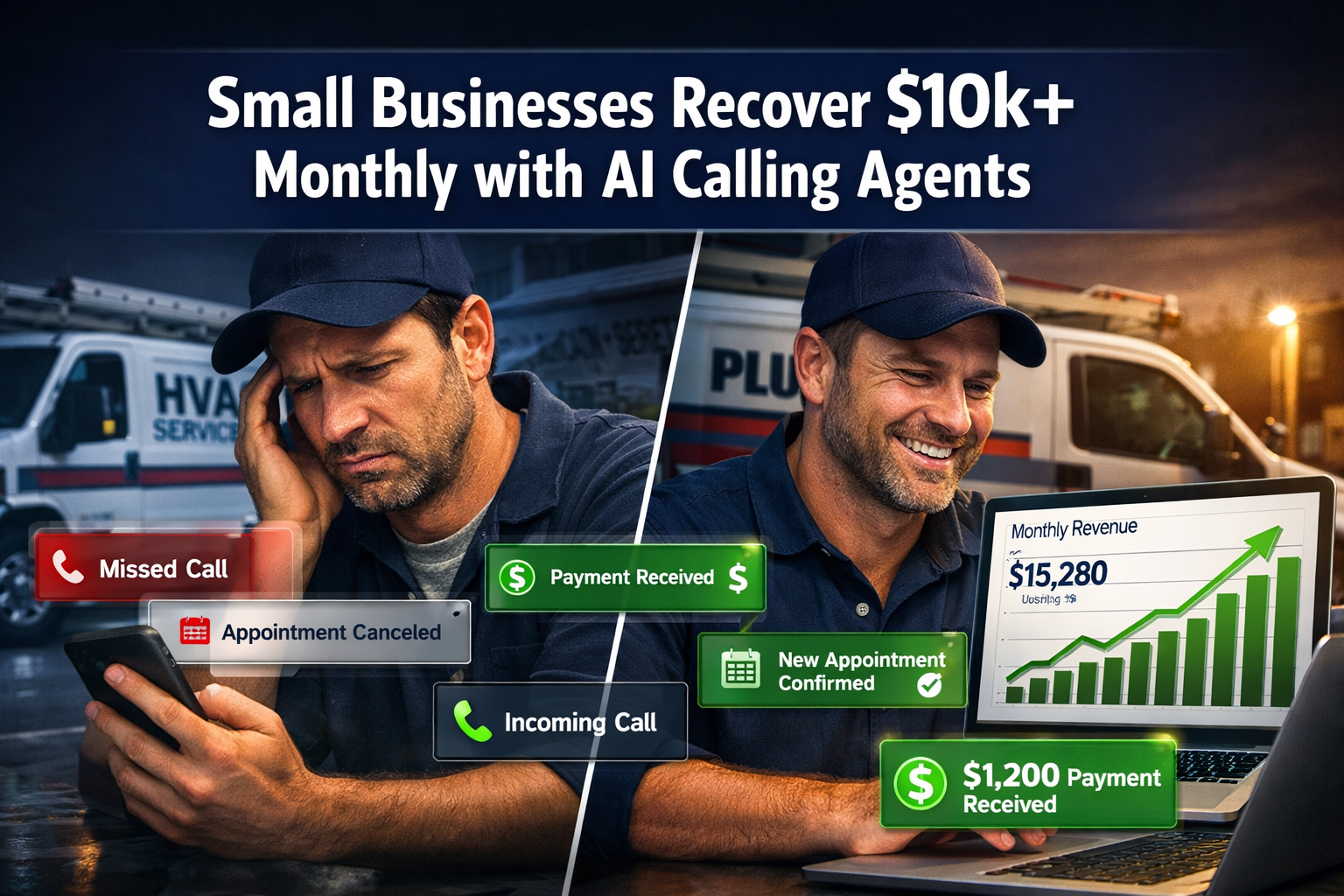
Picture this: It’s 6:47 PM on a Tuesday. Your HVAC business just closed for the day. A homeowner’s AC unit dies in the middle of a heatwave, and they desperately call your number. The phone rings. And rings. And goes to voicemail. Frustrated, they call your competitor—who answers immediately with an AI voice agent that books the emergency appointment in under two minutes. That single missed call? Worth $850 in lost revenue. Multiply that by the 62% of inbound calls that small businesses miss every month[1], and you’re looking at a silent profit killer bleeding your business dry.
The cost of missed customer calls for contractors, medical practices, legal firms, and home service businesses isn’t just frustrating—it’s financially devastating. But here’s the breakthrough: AI voice agents for small business ROI are now capturing those “lost” calls and converting them into booked appointments, recovered revenue, and measurable growth. Small businesses are recovering $10,000 to $40,000+ monthly by deploying hyper-realistic AI calling agents that never sleep, never miss a call, and turn every inquiry into opportunity.
Key Takeaways
- 62% of small business calls go unanswered, creating a massive revenue leak that AI voice agents eliminate by providing 24/7 coverage[1]
- Businesses typically recover 20-40% of previously lost revenue within the first quarter of implementing automated lead recovery systems for local business[1]
- After-hours AI agents achieve 60-70% conversion rates during periods when traditional businesses miss 100% of calls[4]
- ROI timelines run 3-6 months for most small businesses, with immediate savings from reduced staffing costs and captured missed opportunities[3]
- Real-world case study: Image Orthodontics generated over $400,000 in incremental revenue in one quarter simply by capturing previously missed calls[1]
The Hidden Crisis: How to Calculate Revenue Lost from Missed Calls
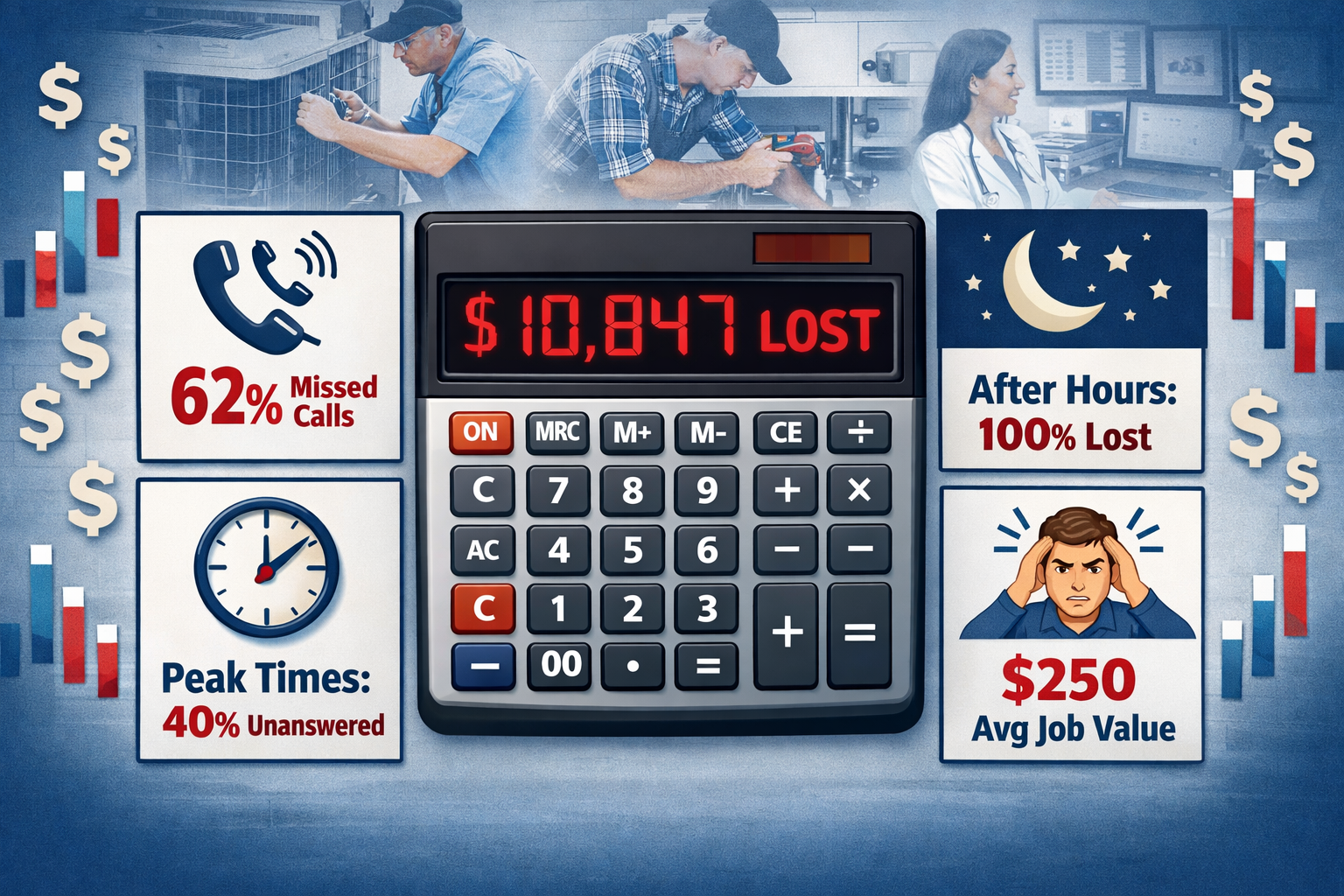
Most business owners know they’re missing calls. Few realize the actual dollar amount hemorrhaging from their bottom line every single month.
The Real Math Behind Lost Revenue
Calculating your missed call crisis starts with brutal honesty about your phone operations. Here’s the formula that reveals your true revenue leak:
Monthly Lost Revenue = (Total Monthly Calls × Missed Call Percentage × Average Job Value × Conversion Rate)
Let’s break down a real-world contractor example:
| Metric | Your Business | Industry Average |
|---|---|---|
| Monthly Inbound Calls | 200 | 150-300 |
| Missed Call Rate | 62%[1] | 55-70% |
| Calls Actually Missed | 124 | 93-210 |
| Average Job Value | $450 | $250-$850 |
| Typical Conversion Rate | 30% | 25-35% |
| Monthly Lost Revenue | $16,740 | $5,800-$49,500 |
That’s not a typo. A mid-sized plumbing or HVAC company with average call volume is likely losing $16,000+ every month to unanswered phones. Scale that across a year, and you’re looking at $200,000 in vanished revenue—money that’s already interested in your services but never makes it onto your calendar.
Peak-Time Revenue Hemorrhaging
The cost of missed customer calls for contractors intensifies during specific windows:
📞 After-Hours Emergencies (5 PM – 8 AM): Traditional businesses miss 100% of these calls. AI voice agents capture them at 60-70% conversion rates[4], turning dormant hours into active revenue streams.
📞 Lunch Rush (11 AM – 1 PM): When your receptionist is eating or overwhelmed, 40% of calls go unanswered. Each missed call during this window represents immediate-need customers with high purchase intent.
📞 Weekend Inquiries: Competitors who answer Saturday calls capture market share while you’re closed. Automated lead recovery systems for local business ensure zero weekend revenue loss.
“Approximately 62% of inbound calls to small businesses go unanswered, representing a critical revenue leak that AI voice agents directly address.”[1]
The Compounding Effect of Call Abandonment
Beyond immediate lost jobs, missed calls create cascading damage:
- Brand Reputation Erosion: Customers who can’t reach you assume you’re unprofessional or too busy for their business
- Competitor Advantage: Every unanswered call is a gift to competitors with better phone coverage
- Negative Review Risk: Frustrated callers leave one-star reviews about poor responsiveness
- Lost Lifetime Value: A single missed call doesn’t just lose one job—it loses potential referrals, repeat business, and long-term customer relationships
The invisible nature of this crisis makes it particularly dangerous. You can’t see the customers who never reached you. But your competitors can see them—because those customers are calling them next.
AI Voice Agents for Small Business ROI: The Revenue Recovery Revolution
The transformation from revenue leak to revenue engine happens when businesses deploy hyper-realistic AI calling agents designed specifically for small business operations.
What Makes Modern AI Voice Agents Different
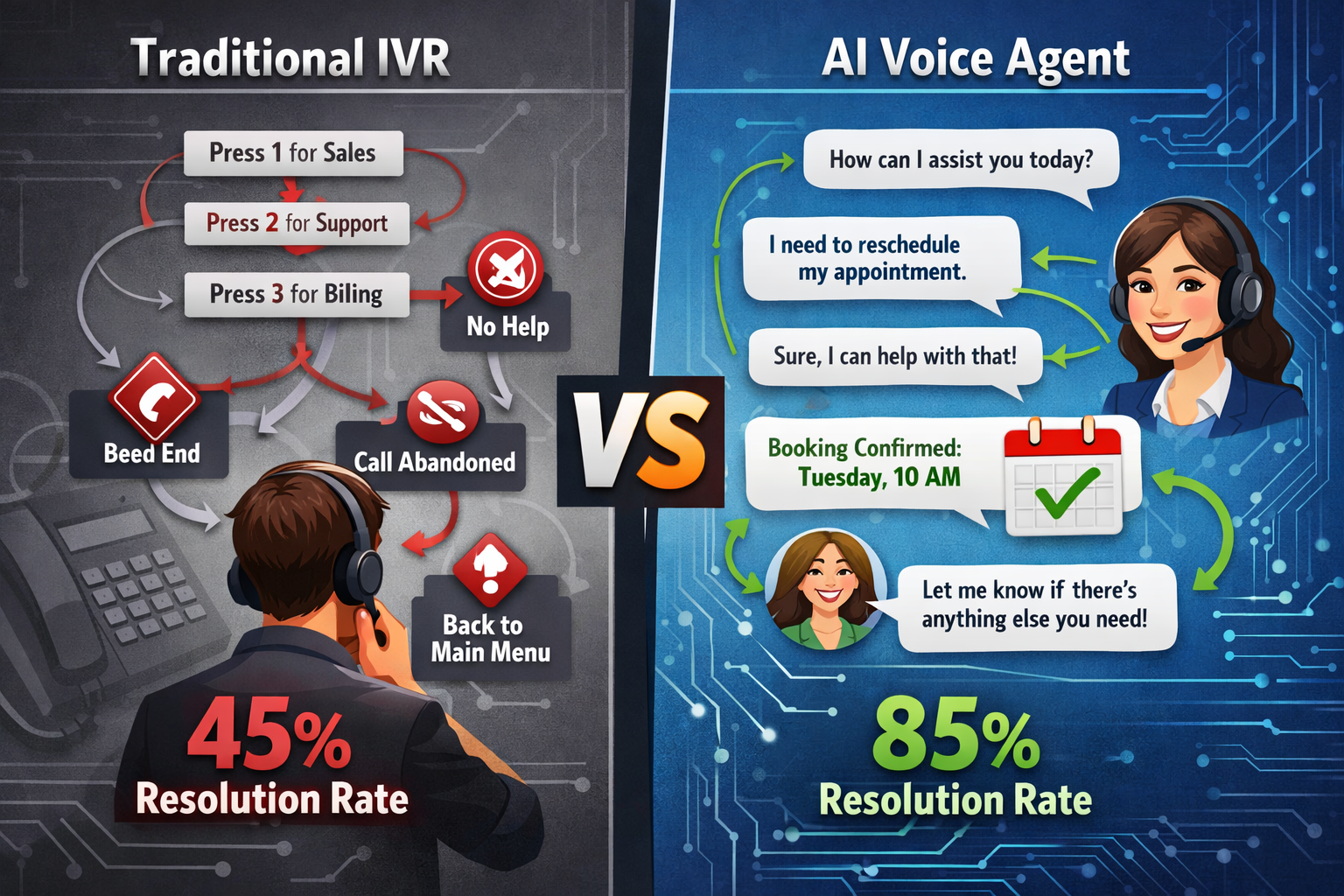
Forget the robotic “press 1 for sales” nightmares of traditional IVR systems. Today’s AI voice agents operate with human-level voice intelligence that understands context, emotion, and intent.
Traditional IVR Systems:
- Rigid menu trees that frustrate callers
- No ability to handle complex questions
- Force customers to navigate endless options
- Zero after-hours conversion capability
- Can’t book appointments or qualify leads
Modern AI Voice Agents (like Callerrs):
- Natural, conversational dialogue that adapts in real-time
- Understand regional accents and emotional cues
- Integrate directly with your CRM and calendar systems
- Book appointments during the conversation—no callbacks needed
- Operate 24/7 with zero wait times and infinite scalability
- Reduce calls requiring human handling by 55-65%[4]
The fundamental difference? AI voice agents are active revenue engines, not passive information handlers. They don’t just answer questions—they qualify leads, schedule appointments, and close deals while you sleep.
Real ROI Numbers: What Small Businesses Actually Recover
The revenue recovery range for automated lead recovery systems for local business typically falls between 20-40% of previously lost revenue[1], but the most sophisticated implementations exceed these benchmarks significantly.
Case Study Spotlight: Image Orthodontics
This Bay Area multi-location orthodontic practice deployed an AI receptionist to capture missed calls. The result? Over $400,000 in incremental revenue within the first quarter alone[1]. The AI agent didn’t replace their human team—it captured the overflow and after-hours calls that were previously falling through the cracks.
Typical Small Business Recovery Breakdown:
💰 Month 1-2: Immediate staffing cost savings + after-hours call capture = $3,000-$5,000 recovered
💰 Month 3-4: Full integration + peak-time overflow handling = $7,000-$12,000 recovered
💰 Month 5-6: Optimized workflows + proactive outbound follow-up = $10,000-$18,000+ recovered
Most small businesses hit positive ROI within three to six months[3], with the fastest returns coming from businesses that previously used expensive outsourced answering services or had significant after-hours call volume.
The Staffing Cost Multiplier
Beyond recovered revenue, AI voice agents dramatically reduce operational costs:
Full-Time Receptionist Costs (Annual):
- Base Salary: $35,000-$45,000
- Benefits (30%): $10,500-$13,500
- Training & Onboarding: $3,000-$5,000
- Sick Days & Coverage: $2,000-$4,000
- Total Annual Cost: $50,500-$67,500
AI Voice Agent Costs (Annual):
- Platform Subscription: $3,000-$12,000
- Integration Setup: $500-$2,000
- Total Annual Cost: $3,500-$14,000
Net Savings: $36,500-$63,500 annually
But here’s where the math gets even better: Unlike human receptionists who handle one call at a time, AI voice agents manage unlimited concurrent calls. During your busiest periods—when you’d need 2-3 receptionists to handle volume—a single AI agent scales infinitely without additional cost.
After-Hours: The Dormant Goldmine
The most dramatic ROI gains come from capturing after-hours revenue that traditional businesses miss entirely.
Consider a personal injury law firm receiving 50 calls per month outside business hours. Traditional response: voicemail. Conversion rate: 5-8% (the few desperate enough to leave detailed messages and wait for callbacks).
With an AI voice agent handling after-hours intake:
- Conversion Rate: 60-70%[4]
- 50 after-hours calls × 65% conversion × $8,000 average case value = $260,000 monthly revenue from previously dormant hours
For service businesses like HVAC and plumbing companies, emergency after-hours calls carry premium pricing. Missing these calls doesn’t just lose revenue—it loses the highest-margin revenue your business can generate.
Automated Lead Recovery Systems for Local Business: Implementation That Actually Works
Understanding ROI potential is one thing. Capturing it requires strategic implementation that goes beyond basic “set it and forget it” automation.
The Three Pillars of Effective AI Voice Agent Deployment
1. Intelligent Workflow Integration
Top-performing AI voice agents don’t operate in isolation—they integrate seamlessly with your existing business systems:
✅ CRM Integration: Automatically log every call, capture lead details, and update customer records in platforms like GoHighLevel, HubSpot, and Salesforce
✅ Calendar Synchronization: Lock appointment slots in real-time during conversations with Calendly, Acuity, and custom scheduling systems—no double-bookings, no manual follow-up
✅ Payment Processing: Collect deposits, process payments, and confirm bookings without human intervention
✅ Escalation Protocols: Intelligently route complex cases to human team members based on sentiment analysis and conversation context
The businesses recovering $10k+ monthly don’t just answer calls—they convert them into booked, paid appointments before the conversation ends.
2. Hyper-Realistic Conversation Design
The difference between a good AI voice agent and a great one comes down to conversation quality. Modern solutions like Callerrs employ:
- Regional Accent Recognition: Understanding diverse caller speech patterns across all 50 states
- Emotional Intelligence: Detecting frustration, urgency, or confusion and adapting responses accordingly
- Natural Language Processing: Moving beyond scripted responses to genuine conversational flow
- Objection Handling: Addressing price concerns, scheduling conflicts, and hesitations with persuasive, human-like responses
“AI agents hold natural, human-like conversations that adapt to objections, assess customer sentiment, and offer personalized win-back incentives in real time.”[2]
This human-level voice intelligence separates functional revenue recovery from basic call answering.
3. Proactive Outbound Recovery
The most sophisticated automated lead recovery systems don’t just wait for inbound calls—they actively pursue lost opportunities:
📞 Abandoned Call Follow-Up: When someone hangs up before booking, the AI agent calls back within minutes to complete the appointment
📞 Cold Lead Reactivation: Automatically contact leads from 30, 60, or 90 days ago who never converted, offering special incentives to book now
📞 Appointment Confirmation: Reduce no-shows by 40-60% with automated reminder calls that sound completely human
📞 Customer Win-Back Campaigns: Re-engage past customers who haven’t used your services in 6+ months with personalized outreach
This proactive approach transforms AI voice agents from defensive tools (preventing missed calls) into offensive weapons (actively generating new revenue from dormant lists).
Industry-Specific Implementation Strategies
Different service businesses require tailored approaches to maximize ROI:
🔧 HVAC & Plumbing Contractors:
- Priority: Emergency after-hours call capture
- Key Integration: Dispatch software and technician scheduling
- ROI Driver: Premium emergency pricing + reduced missed service calls
- Average Recovery: $12,000-$25,000 monthly
⚖️ Legal Practices (Personal Injury):
- Priority: Detailed intake automation and qualification
- Key Integration: Case management systems and conflict checking
- ROI Driver: High case values + 24/7 lead capture
- Average Recovery: $15,000-$50,000+ monthly
🏥 Medical & Dental Practices:
- Priority: HIPAA-compliant appointment scheduling
- Key Integration: EHR systems and insurance verification
- ROI Driver: Reduced no-shows + expanded booking hours
- Average Recovery: $8,000-$20,000 monthly
🏠 Real Estate Agencies:
- Priority: Property inquiry handling and showing scheduling
- Key Integration: MLS systems and agent calendars
- ROI Driver: Lead response speed + after-hours capture
- Average Recovery: $10,000-$30,000 monthly
Measuring Success: The Metrics That Matter
To truly understand your AI voice agents for small business ROI, track these critical KPIs:
| Metric | Before AI Agent | After AI Agent | Improvement |
|---|---|---|---|
| Call Answer Rate | 38% | 100% | +163% |
| After-Hours Conversion | 0% | 65% | Infinite |
| Average Response Time | 4.2 hours | 8 seconds | -99.9% |
| Calls to Human Agents | 100% | 35-45% | -55-65%[4] |
| First-Call Resolution | 48% | 82% | +71% |
| Monthly Revenue from Calls | Baseline | +$10k-$40k | +20-40%[1] |
The businesses seeing the highest returns obsessively track these numbers and continuously optimize their AI agent workflows based on real performance data.
The Competitive Advantage: Why Early Adopters Win
As of February 2026, over 15,000 AI agents have been deployed across industries including dental practices, restaurants, home services, and cleaning businesses[1]. The platform infrastructure supporting these deployments has matured rapidly, with leading providers like Newo operating networks of over 200 certified partners[1].
This ecosystem growth signals a critical inflection point: AI voice agents are transitioning from cutting-edge technology to competitive necessity.
The First-Mover Window
Businesses implementing AI voice agents in 2026 capture three distinct advantages:
1. Market Share Capture: While competitors still miss 62% of calls, your 100% answer rate becomes a powerful differentiator. Every competitor’s missed call becomes your gained customer.
2. Customer Expectation Setting: As AI voice agents become standard, customers will expect instant, 24/7 response. Early adopters shape these expectations rather than scrambling to meet them.
3. Operational Learning Curve: The businesses that master AI voice agent integration now will have refined, optimized systems while competitors are still figuring out basic implementation.
“More than 15,000 AI agents have been created on the Newo platform across industries… with the company doubling revenue in the final two months of 2025 and maintaining accelerated customer demand through early 2026.”[1]
Beyond Cost Savings: The Strategic Value
The conversation around AI voice agents often focuses on cost reduction and revenue recovery. But the strategic advantages extend far deeper:
🎯 Infinite Scalability: Your business capacity becomes unlimited. Whether you receive 10 calls or 10,000 calls simultaneously, every customer gets immediate, personalized attention.
🎯 Data Intelligence: Every conversation generates actionable insights—common objections, peak call times, service requests, pricing sensitivity—that inform broader business strategy.
🎯 Team Empowerment: By reducing agent burnout from low-value calls by 55-65%[4], AI agents improve retention of your best human team members who can focus on complex, high-value interactions.
🎯 Geographic Expansion: Open new markets without hiring local staff. Your AI voice agent handles inquiries from anywhere with the same quality and consistency.
🎯 Multilingual Capability: Modern AI voice agents support 50+ languages, allowing small businesses to serve diverse communities without multilingual hiring costs.
Taking Action: Your Revenue Recovery Roadmap
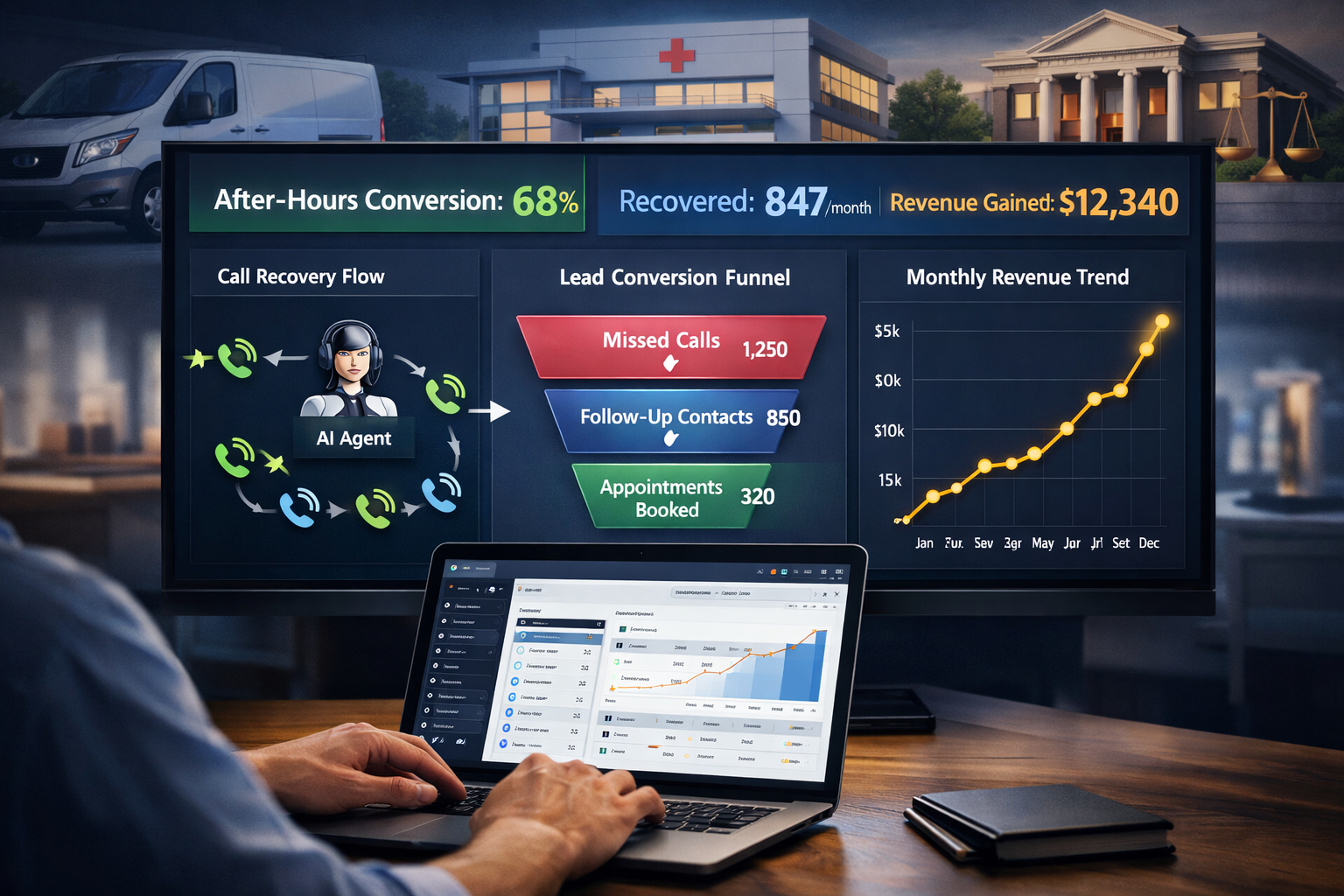
The gap between understanding AI voice agent ROI and actually recovering $10k+ monthly comes down to execution. Here’s your step-by-step implementation roadmap:
Phase 1: Audit Your Current Call Performance (Week 1)
Before implementing any solution, establish your baseline:
- Track Total Call Volume: Use your phone system analytics to identify monthly inbound call volume
- Calculate Missed Call Rate: Determine what percentage of calls go unanswered (industry average: 62%[1])
- Identify Peak Miss Times: When do most missed calls occur? After-hours? Lunch? Peak season?
- Determine Average Job Value: What’s the typical revenue per converted customer?
- Estimate Current Lost Revenue: Apply the formula from earlier in this article
This audit reveals your true revenue leak and sets measurable benchmarks for improvement.
Phase 2: Define Your Use Case (Week 2)
Not all AI voice agent implementations are created equal. Define your specific priorities:
- Primary Goal: After-hours coverage? Peak-time overflow? Complete receptionist replacement?
- Integration Requirements: Which CRM, calendar, and business systems must connect?
- Compliance Needs: HIPAA for medical? SOC2 for enterprise? Industry-specific regulations?
- Conversation Complexity: Simple appointment booking or detailed qualification workflows?
Your answers determine which AI voice agent platform best fits your business model.
Phase 3: Select Your Platform (Week 3-4)
Evaluate AI voice agent providers based on these critical criteria:
✅ Conversation Quality: Request live demos with your actual business scenarios—not scripted showcases
✅ Integration Depth: Verify native connections to your existing tech stack
✅ Scalability: Confirm unlimited concurrent call handling without per-call pricing
✅ Compliance: Ensure enterprise-grade security, especially for regulated industries
✅ Support & Training: Look for certified implementation partners and ongoing optimization support
Platforms like Callerrs excel specifically in hyper-realistic voice automation for US businesses, with proven track records in preventing missed customer calls and delivering measurable ROI for service-based businesses.
Phase 4: Implementation & Optimization (Week 5-8)
Successful deployment follows this sequence:
Week 5: Initial setup and workflow configuration Week 6: Integration with CRM, calendar, and business systems Week 7: Testing with real calls and conversation refinement Week 8: Full launch with human oversight and rapid iteration
The businesses that recover revenue fastest treat the first 30 days as active optimization—not passive deployment. Monitor every conversation, identify friction points, and continuously refine your AI agent’s responses.
Phase 5: Measure, Scale, and Expand (Month 3+)
Once your AI voice agent is operational:
📊 Track ROI Metrics: Monitor the KPIs outlined earlier—answer rates, conversion rates, revenue recovery
📊 Expand Use Cases: Add outbound lead recovery, appointment reminders, customer reactivation campaigns
📊 Optimize Workflows: Use conversation analytics to identify and eliminate bottlenecks
📊 Scale Across Locations: Deploy proven workflows to additional business locations or service areas
Most businesses see measurable ROI within 3-6 months[3], with compounding returns as workflows mature and expand.
Conclusion: The $10k+ Monthly Opportunity Waiting in Your Missed Calls
The revenue your business is losing to missed calls isn’t theoretical—it’s quantifiable, recoverable, and waiting for you to capture it. Every unanswered phone call represents a customer who was interested enough to reach out, ready enough to take action, and frustrated enough to call your competitor next.
The mathematics are undeniable:
- 62% of small business calls go unanswered[1]
- Businesses recover 20-40% of lost revenue with AI voice agents[1]
- After-hours AI agents convert at 60-70% rates during periods when traditional businesses convert at 0%[4]
- Real businesses like Image Orthodontics generate $400,000+ in incremental quarterly revenue[1] simply by answering the phone
The question isn’t whether AI voice agents deliver ROI—the data proves they do. The question is whether your business will capture this opportunity before your competitors do.
Your next steps:
- Calculate your current revenue leak using the formulas in this article
- Audit your call performance to identify your biggest opportunity areas
- Explore hyper-realistic AI voice solutions like Callerrs that integrate seamlessly with your existing systems
- Start with high-impact use cases (after-hours coverage, peak-time overflow) that deliver immediate returns
- Measure, optimize, and scale as your AI voice agent proves its value
The future of customer communication isn’t about replacing human connection—it’s about ensuring every customer gets the immediate, intelligent response they deserve, whether they call at 2 PM or 2 AM. Your competitors are already implementing these systems. Your customers are already expecting this level of responsiveness.
The only question left is: How much longer can your business afford to let $10,000+ in monthly revenue slip through the cracks?
Ready to stop missing calls and start recovering revenue? Discover how Callerrs’ hyper-realistic AI voice agents can transform your phone system from a cost center into a 24/7 revenue engine.
References
[1] Newo Raises 25m Series A Led By Ratmir Timashev To Scale Ai Voice Infrastructure For Small Businesses – https://www.globenewswire.com/news-release/2026/02/10/3235416/0/en/Newo-Raises-25M-Series-A-Led-by-Ratmir-Timashev-to-Scale-AI-Voice-Infrastructure-for-Small-Businesses.html
[2] The 10 Best Ai Reactivation Agents To Bring Lost Customers Back – https://www.petegabi.com/2026/01/06/the-10-best-ai-reactivation-agents-to-bring-lost-customers-back/
[3] How To Measure Roi From Voice Agents – https://www.goodcall.com/voice-ai/how-to-measure-roi-from-voice-agents
[4] Ai Phone Assistants In 2026 How They Answer Qualify And Convert Calls – https://unleashx.ai/blogs/ai-phone-assistants-in-2026-how-they-answer-qualify-and-convert-calls/
[5] Which Ai Voice Agent Is Best For Small Businesses – https://www.oncehub.com/blog/which-ai-voice-agent-is-best-for-small-businesses