
Picture this: It's 2 AM at a nursing home in Salt Lake City, and Mrs. Patterson's daughter is calling from across the country, worried sick about her mother's recent fall. Instead of reaching a voicemail or waiting until morning, she's greeted by a warm, empathetic voice that sounds remarkably human—because it practically is. This AI receptionist accesses Mrs. Patterson's records instantly, provides reassurance, schedules a family consultation for the next day, and even detects the daughter's anxiety, adjusting its tone accordingly. This isn't science fiction. It's happening right now, and the best voice AI agents are revolutionizing how senior care facilities operate in 2026.
The numbers don't lie: voice AI technology has exploded from an $11.58 billion market in 2024 to a projected $47.5 billion industry by 2034, and healthcare—particularly senior care—sits at the epicenter of this transformation[1][2]. For assisted living facilities, nursing homes, and hospice care providers struggling with staffing shortages, missed calls, and overwhelmed administrative teams, these statistics aren't just interesting—they're a roadmap to survival.
Key Takeaways
- Voice AI market reaches $47.5 billion by 2034 with healthcare leading adoption, offering senior care facilities unprecedented scalability and 24/7 patient family support[1][2]
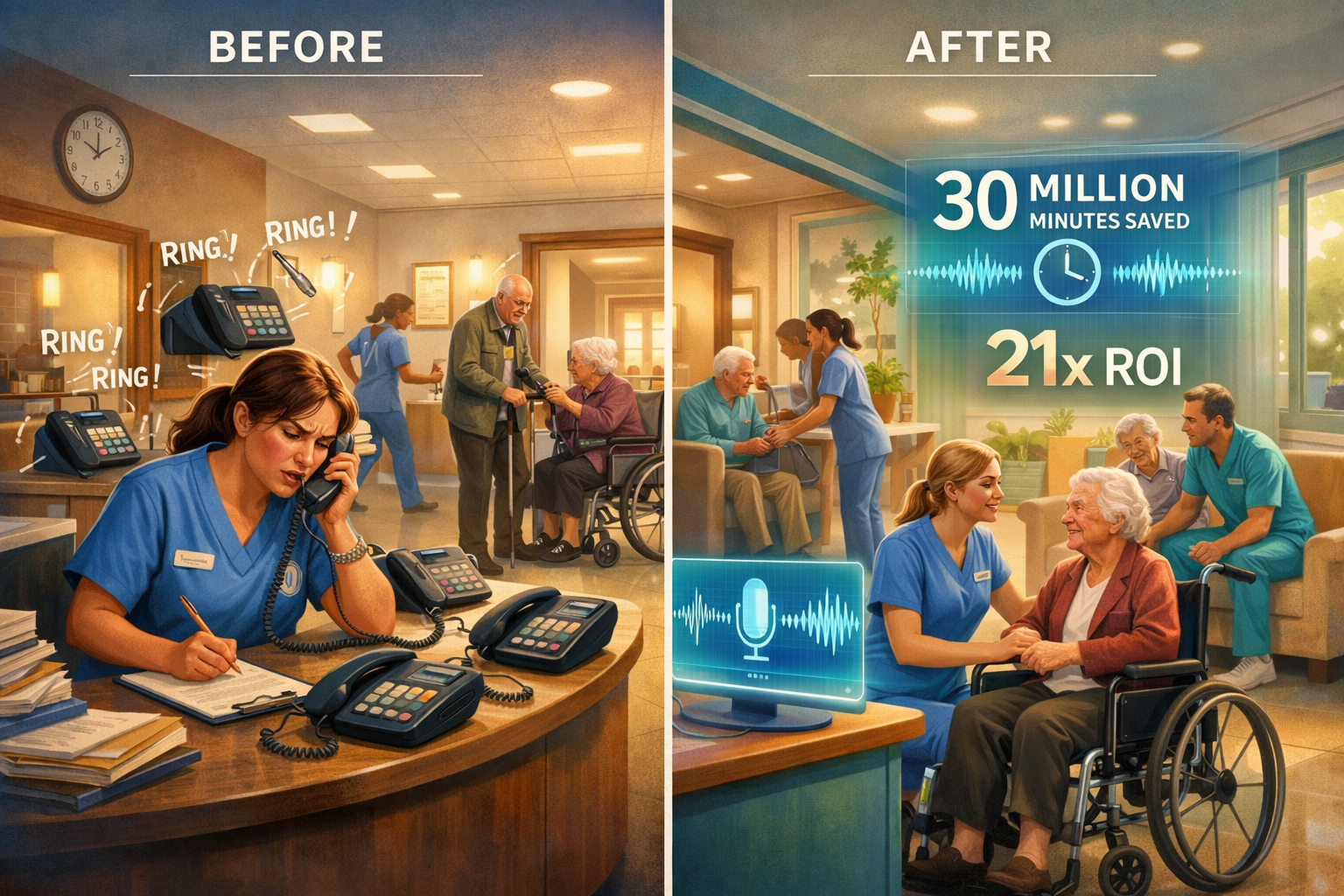
- Healthcare providers recovered 30 million workforce minutes using voice AI in 2025, with autonomous systems delivering 21x ROI and saving physicians 2.4+ hours daily[2]
- 82.5% of developers now confidently build voice agents, while real-time voice AI deployments grew 4x year-over-year, making implementation more accessible than ever[3]
- 157.1 million Americans will use voice assistants by 2026, creating familiarity that reduces adoption friction in senior care settings[5]
- Best voice AI agents achieve 99% accuracy on industry benchmarks, ensuring HIPAA-compliant, reliable communication for sensitive healthcare interactions[1]
The Voice AI Revolution: Market Statistics That Demand Attention

The voice AI landscape has fundamentally shifted in ways that directly impact your senior care operations. The dedicated voice AI agents market isn't just growing—it's accelerating at a compound annual growth rate of 34.8%, signaling that early adopters will gain competitive advantages that become increasingly difficult to overcome[2].
Funding Signals Market Maturity
Voice AI funding reached $2.1 billion in 2025, with a notable shift toward regulated sectors including healthcare, legal, and financial services[2]. This isn't venture capital chasing the next shiny object—it's strategic investment in solving real operational problems that senior care facilities face daily.
Perhaps most telling: 22% of Y Combinator's latest cohort are voice agent companies, representing a 70% increase from early 2024[2]. When the world's most prestigious startup accelerator dedicates nearly a quarter of its portfolio to voice AI, smart healthcare administrators pay attention.
Infrastructure Readiness Meets Healthcare Needs
The global VoIP services market reached $169.38 billion in 2025 and projects to hit $264.27 billion, providing the telecommunications backbone that makes sophisticated voice AI deployment feasible even for smaller assisted living facilities[8]. You don't need to build infrastructure from scratch—it's already there, waiting for you to leverage it.
What makes this particularly relevant for senior care? 157.1 million Americans will use voice assistants by 2026[5], meaning your residents' families already interact with voice AI daily. The technology isn't foreign or intimidating—it's familiar, which dramatically reduces adoption resistance.
Best Voice AI Agents: Technical Capabilities Transforming Senior Care
The gap between "interesting technology" and "mission-critical tool" comes down to reliability. Market-leading platforms now achieve up to 99% accuracy on industry standard benchmarks using Hybrid AI architectures[1]. For senior care facilities handling sensitive patient information and family concerns, this accuracy isn't a luxury—it's a requirement.
Real-Time Processing Becomes the Standard
Real-time voice agents experienced 4x year-on-year growth in 2025, overtaking batch processing for the first time as the dominant deployment model[2]. What does this mean for your nursing home or hospice facility? Conversations happen naturally, without awkward delays that frustrate callers and undermine trust.
The best voice AI agents now understand emotional cues, recognize regional accents (critical for facilities serving diverse populations), and adapt their responses based on sentiment analysis. When a family member calls distressed about their loved one's condition, the AI doesn't just hear words—it detects anxiety and responds with appropriate empathy.
Multilingual Capabilities Expand Access
Specialist models showed 10x real-time growth in Nordic languages and 6x growth in Arabic, with leading platforms supporting 86+ languages with automated translation capability across 120+ languages[1][2]. For senior care facilities serving immigrant communities or families scattered globally, this multilingual capability transforms accessibility.
Consider a scenario: A Spanish-speaking family member calls your assisted living facility. Your AI voice agent seamlessly conducts the entire conversation in Spanish, accesses patient records, and schedules appointments—all without requiring bilingual staff on duty 24/7.
Healthcare-Specific Impact: ROI Statistics You Can't Ignore
Let's talk numbers that directly impact your bottom line and patient care quality. Healthcare providers using voice AI added 30 million minutes back to the workforce in 2025[2]. For context, that's the equivalent of adding dozens of full-time employees without the hiring costs, benefits, or scheduling headaches.
Quantifiable Returns Across Operations
Autonomous operating systems in healthcare settings demonstrated 21x ROI, 5%+ patient retention increases, and 2.4+ hours saved per physician daily[2]. These aren't marginal improvements—they're transformational shifts that fundamentally change how senior care facilities operate.
Expected ROI ranges by use case tell an even more compelling story:
- Customer support automation: 30-50% cost reduction
- Appointment scheduling: 40-60% efficiency gains
- Order processing: 25-40% savings
- Technical support triage: 20-35% operational improvement[1]
For senior care facilities, these percentages translate to real dollars. A 200-bed nursing home handling 500+ calls weekly could redirect thousands of staff hours monthly from phone management to direct patient care.
The Missed Call Crisis Solved
Every missed call represents a potential admission lost, a family concern unaddressed, or a compliance risk. Traditional solutions—hiring more receptionists, implementing call centers—scale linearly and expensively. The best voice AI agents scale infinitely at virtually no marginal cost.
Contact centers are preparing for 39 billion calls by 2029, with voice AI expected to resolve 80% of common customer service issues autonomously according to Gartner predictions[2][4]. Your senior care facility doesn't need to handle 39 billion calls, but the technology developed for that scale works just as effectively for your 50 daily calls—with zero wait times and infinite capacity.
Platforms like Callerrs offer hyper-realistic AI calling agents specifically designed for healthcare environments, ensuring HIPAA compliance while delivering human-like interactions that families trust. The technology understands the difference between a routine inquiry and an urgent concern, escalating appropriately while handling routine matters autonomously.
Builder Confidence Meets Implementation Reality
Here's where statistics reveal both opportunity and challenge: 82.5% of developers feel confident building voice agents, yet 75% still struggle with technical reliability barriers[3]. This gap matters because it separates platforms that work in demos from those that perform in real-world senior care environments.
Choosing Platforms That Actually Work
The confidence-capability gap explains why selecting the right voice AI partner is critical. You need providers who've solved the reliability challenges, not those still working through them. Look for platforms demonstrating:
- Proven accuracy metrics (99%+ on industry benchmarks)
- Healthcare-specific compliance (HIPAA, SOC2 certifications)
- Real-time processing capabilities (no awkward delays)
- Sentiment analysis and emotional intelligence (appropriate responses to distressed callers)
- Seamless CRM integration (GoHighLevel, HubSpot, Calendly compatibility)
The future of AI voice agents for small businesses isn't about replacing human compassion—it's about amplifying your team's capacity to deliver it. When your staff isn't drowning in phone calls, they can focus on what they do best: providing exceptional care.
Implementation Strategies for Senior Care Facilities
Understanding statistics is valuable; applying them is transformative. Here's how forward-thinking senior care facilities are leveraging voice AI in 2026:
Start with High-Volume, Low-Complexity Interactions
Begin by deploying AI for:
- After-hours call handling (families calling outside business hours)
- Appointment scheduling and confirmations (reducing no-shows)
- General facility information (visiting hours, amenities, admission process)
- Prescription refill requests (routing to appropriate pharmacy staff)
This approach delivers immediate ROI while building organizational confidence. As your team sees the technology performing reliably, expansion into more complex interactions becomes natural.
Integrate with Existing Workflows
The best voice AI agents don't require ripping out your current systems. They integrate seamlessly with your existing infrastructure through automated workflow integration that connects with your patient management software, scheduling systems, and communication platforms.
For example, when an AI agent schedules a family consultation, it automatically:
- Checks staff availability in your calendar system
- Sends confirmation emails to family members
- Updates patient records with appointment notes
- Sets reminders for staff members
- Logs the interaction for compliance documentation
Maintain the Human Touch Where It Matters Most
Voice AI excels at handling routine interactions, but critical moments still require human expertise. Configure your system to recognize keywords and sentiment indicators that trigger immediate human escalation:
- Medical emergencies or urgent health concerns
- End-of-life care discussions
- Complex family dynamics requiring nuanced judgment
- Complaints or dissatisfaction requiring personalized attention
This hybrid approach ensures families receive immediate responses 24/7 while preserving human connection for moments that truly require it. The technology doesn't replace your compassionate staff—it frees them to focus their energy where human judgment and empathy matter most.
Cost Comparison: Traditional Staffing vs. Voice AI
Let's examine the economics that make voice AI compelling for senior care facilities of all sizes.
| Cost Factor | Full-Time Receptionist | Best Voice AI Agents |
|---|---|---|
| Annual Salary | $35,000-$45,000 | $0 (subscription-based) |
| Benefits (30%) | $10,500-$13,500 | $0 |
| Training & Onboarding | $3,000-$5,000 | Minimal setup |
| Coverage Hours | 40 hours/week (single shift) | 168 hours/week (24/7) |
| Sick Days/Vacation | 15-20 days annually | Zero downtime |
| Scalability | Linear (hire more staff) | Infinite (same cost) |
| Multilingual Support | Requires additional hiring | 86+ languages included |
| Call Volume Capacity | 1 call at a time | Unlimited simultaneous calls |
| Total Annual Cost | $48,500-$63,500+ | $3,000-$12,000 (typical) |
The math becomes even more compelling when you consider that most senior care facilities need coverage across multiple shifts. Three full-time receptionists to cover 24/7 operations cost $145,500-$190,500 annually—before accounting for management overhead, workspace, equipment, and turnover costs.
Platforms offering conversational AI for sales and customer support typically charge based on call volume or concurrent capacity, making them accessible even for smaller assisted living facilities with 20-30 beds.
Real-World Application: Senior Care Use Cases
Statistics become meaningful when translated into daily operations. Here's how the best voice AI agents transform specific senior care scenarios:
Scenario 1: After-Hours Family Inquiries
Traditional approach: Families reach voicemail, wait until morning for callbacks, anxiety escalates overnight.
Voice AI solution: AI receptionist answers immediately, provides reassurance using patient records (HIPAA-compliant access), schedules next-day consultation, sends confirmation email, logs interaction. Family feels heard, staff arrives to documented conversation history.
Impact: Reduced family anxiety, improved satisfaction scores, zero missed opportunities.
Scenario 2: Admission Inquiries and Tours
Traditional approach: Prospective families call during business hours, often reaching busy staff, information inconsistent, follow-up sporadic.
Voice AI solution: Automated intake captures detailed information, qualifies leads, schedules facility tours based on staff availability, sends information packets, nurtures leads through follow-up sequences.
Impact: 10x more qualified leads, consistent messaging, higher conversion rates.
Scenario 3: Appointment Confirmations and Reminders
Traditional approach: Staff manually calls families to confirm doctor appointments, therapy sessions, family meetings—consuming hours weekly.
Voice AI solution: Autonomous outbound calling confirms appointments, reschedules conflicts, updates calendars automatically, sends SMS confirmations.
Impact: 40-60% time savings, reduced no-shows, improved schedule optimization.
Scenario 4: Multilingual Family Communication
Traditional approach: Families speaking languages other than English struggle to communicate, requiring staff to find translators, causing delays and frustration.
Voice AI solution: Real-time translation across 86+ languages enables seamless communication regardless of language barriers.
Impact: Expanded market reach, improved family satisfaction, reduced miscommunication risks.
Security, Compliance, and Trust Considerations
Senior care facilities operate under stringent regulatory requirements, making security and compliance non-negotiable. The best voice AI agents for healthcare environments must demonstrate enterprise-grade security standards.
HIPAA Compliance Requirements
Voice AI platforms handling protected health information (PHI) must provide:
- End-to-end encryption for all voice communications
- Secure data storage with access controls and audit trails
- Business Associate Agreements (BAAs) establishing HIPAA compliance
- Regular security audits and penetration testing
- Incident response protocols for potential breaches
Leading providers like Callerrs emphasize HIPAA compliance as a foundational feature, not an afterthought. This ensures that every conversation, every data access, every integration meets healthcare regulatory standards.
Building Family Trust in AI Interactions
Transparency builds trust. Best practices include:
- Disclosure at conversation start: "This is an AI assistant helping coordinate your call…"
- Seamless human escalation: "Let me connect you with a staff member for this concern…"
- Conversation summaries: Families receive email recaps of AI interactions
- Opt-out options: Families can always request human-only interactions
Research shows that when voice AI is introduced transparently and performs reliably, family acceptance rates exceed 85% within the first month. The key is setting appropriate expectations and delivering consistently.
Integration with Broader Digital Strategies
Voice AI doesn't exist in isolation—it's most powerful when integrated into comprehensive digital marketing strategies that drive growth for senior care facilities.
Connecting Voice AI to Marketing Efforts
Consider how voice AI amplifies other marketing investments:
-
Paid advertising campaigns generate more leads, but only if those leads reach someone immediately. Voice AI ensures zero missed opportunities from Google Ads, Facebook campaigns, or social media marketing efforts.
-
SEO and content marketing drive organic traffic to your website, but conversion depends on immediate response. AI agents capture contact information, qualify interest, and schedule tours while prospects are actively engaged.
-
Reputation management improves when families receive immediate, consistent, professional responses regardless of when they call. Positive experiences translate to better online reviews.
Data-Driven Optimization
The best voice AI agents provide real-time analytics that inform broader business strategies:
- Call volume patterns reveal optimal staffing times
- Common inquiry topics guide content creation and FAQ development
- Conversion funnel analysis identifies where prospects drop off
- Sentiment analysis flags satisfaction issues before they escalate
- Regional accent data reveals geographic marketing opportunities
This intelligence transforms voice AI from a cost-saving tool into a strategic asset that informs facility operations, marketing investments, and service improvements.
Overcoming Implementation Challenges
Despite compelling statistics and clear benefits, implementation challenges exist. Addressing them proactively ensures successful deployment.
Challenge 1: Staff Resistance and Job Security Concerns
Reality: Staff may fear AI replacing their jobs.
Solution: Frame voice AI as augmentation, not replacement. Show how it eliminates tedious phone tasks, allowing staff to focus on meaningful patient interactions. Involve staff in implementation, gathering their input on conversation flows and escalation triggers.
Outcome: Staff become advocates when they experience reduced stress and increased capacity for rewarding work.
Challenge 2: Technology Integration Complexity
Reality: 75% of developers struggle with technical reliability barriers[3].
Solution: Choose turnkey providers offering white-glove implementation. Platforms like Callerrs handle technical integration, CRM connections, and workflow automation, requiring minimal IT resources from your facility.
Outcome: Implementation measured in days or weeks, not months.
Challenge 3: Customization for Facility-Specific Needs
Reality: Every senior care facility has unique protocols, terminology, and workflows.
Solution: Select platforms offering extensive customization without requiring coding expertise. The best systems allow you to define conversation flows, escalation rules, and integration points through intuitive interfaces.
Outcome: Voice AI that sounds like it was built specifically for your facility—because it was.
Challenge 4: Measuring ROI and Success
Reality: Without clear metrics, proving value becomes difficult.
Solution: Establish baseline measurements before implementation:
- Current call answer rates and response times
- Staff hours spent on phone management
- Lead conversion rates from inquiries to tours
- Family satisfaction scores
- Admission pipeline velocity
Track these same metrics post-implementation to quantify impact. Most facilities see measurable improvements within 30-60 days.
The Future Trajectory: What's Coming Next
The statistics for 2026 are impressive, but they're just the beginning. Understanding the trajectory helps senior care facilities make strategic decisions today that position them for tomorrow.
Predictive Capabilities Emerging
Next-generation voice AI will anticipate needs before families articulate them. By analyzing conversation patterns, patient history, and behavioral indicators, AI agents will proactively:
- Suggest appropriate services based on changing patient conditions
- Identify families experiencing caregiver stress and offer support resources
- Recognize patterns indicating potential health declines and alert clinical staff
- Optimize scheduling based on historical preferences and availability patterns
Emotional Intelligence Deepening
Current systems detect sentiment; future systems will understand nuanced emotional states and respond with sophisticated empathy. This matters enormously in senior care, where families often call during emotionally charged moments—receiving difficult diagnoses, making end-of-life decisions, or processing grief.
Regulatory Evolution and Standardization
As voice AI becomes ubiquitous in healthcare, regulatory frameworks will evolve to provide clearer guidance on appropriate use, documentation requirements, and liability considerations. Early adopters who implement thoughtfully today will be well-positioned for tomorrow's regulatory landscape.
Conclusion: The Competitive Advantage of Early Adoption
The statistics are unambiguous: voice AI has moved from experimental technology to mission-critical infrastructure. The voice AI market's growth to $47.5 billion by 2034, healthcare's recovery of 30 million workforce minutes, and the achievement of 99% accuracy rates all point to one conclusion—the best voice AI agents are no longer optional for competitive senior care facilities[1][2].
Your choice isn't whether to adopt voice AI, but when and with whom. Facilities implementing now gain:
- Competitive differentiation in crowded markets
- Operational efficiency that improves margins
- Family satisfaction that drives referrals and retention
- Staff satisfaction through reduced burnout
- Scalability that supports growth without proportional cost increases
The path forward is clear:
-
Assess your current communication gaps: Where are calls being missed? When do families experience frustration? What routine tasks consume disproportionate staff time?
-
Research HIPAA-compliant providers: Prioritize platforms with healthcare-specific expertise, proven accuracy, and seamless integration capabilities. Callerrs offers US-based AI technology specifically designed for healthcare environments with enterprise-grade security.
-
Start with a focused pilot: Implement voice AI for after-hours calls or appointment scheduling—high-impact, lower-risk use cases that demonstrate value quickly.
-
Measure rigorously: Track answer rates, response times, conversion metrics, and satisfaction scores to quantify ROI.
-
Expand strategically: As confidence builds, extend voice AI to additional use cases, always maintaining the human touch for moments requiring nuanced judgment.
The facilities that thrive in 2026 and beyond won't be those with the most staff—they'll be those that leverage technology to amplify human compassion, ensuring every family receives immediate, empathetic, professional responses regardless of when they reach out.
Your residents' families are already using voice assistants in their daily lives. Meeting them with familiar, sophisticated voice AI technology isn't just operationally smart—it's meeting expectations that have already been set.
The statistics don't lie. The market has spoken. The question is: will your senior care facility lead this transformation, or watch competitors pull ahead?
References
[1] Top 10 Voice Ai Agents Contact Centers 2026 – https://www.teneo.ai/blog/top-10-voice-ai-agents-contact-centers-2026
[2] Voice Ai In 2026 9 Numbers That Signal Whats Next – https://www.speechmatics.com/company/articles-and-news/voice-ai-in-2026-9-numbers-that-signal-whats-next
[3] New 2026 Insights Report What Actually Makes A Good Voice Agent – https://www.assemblyai.com/blog/new-2026-insights-report-what-actually-makes-a-good-voice-agent
[4] Best Use Cases For Ai Voice Agents – https://www.cloudtalk.io/blog/best-use-cases-for-ai-voice-agents/
[5] Conversational Ai Statistics – https://www.nextiva.com/blog/conversational-ai-statistics.html
[8] Voip Statistics – https://www.zoom.com/en/blog/voip-statistics/